Before vs Now: How the YouTube Algorithm Game Changed in 2025
If you’re still relying on the old playbook — dump more videos, fill titles with keywords, clickbait thumbnails, build up the sub‑count and you’ll grow — you’re behind. Because in 2025 the algorithm changed.
Here’s how creators were winning before — and how the winners are operating now.
🕰️ Before: The Old YouTube Playbook
Upload more videos → Grow faster. The idea: volume and freshness = algorithmic favor.
Heavy focus on SEO keywords & tags in titles/description.
Clickbait thumbnails to grab clicks and drive initial view count.
Shorts dominate: win faster with short‑form over long‑form.
Sub‑count boost = reach. More subs meant more immediate reach and early velocity.
If you followed that formula, you got traction. But those tactics are fading.
Because YouTube doesn’t only care about clicks and uploads anymore.
🚀 Now: The New YouTube Algorithm Rules (2025)
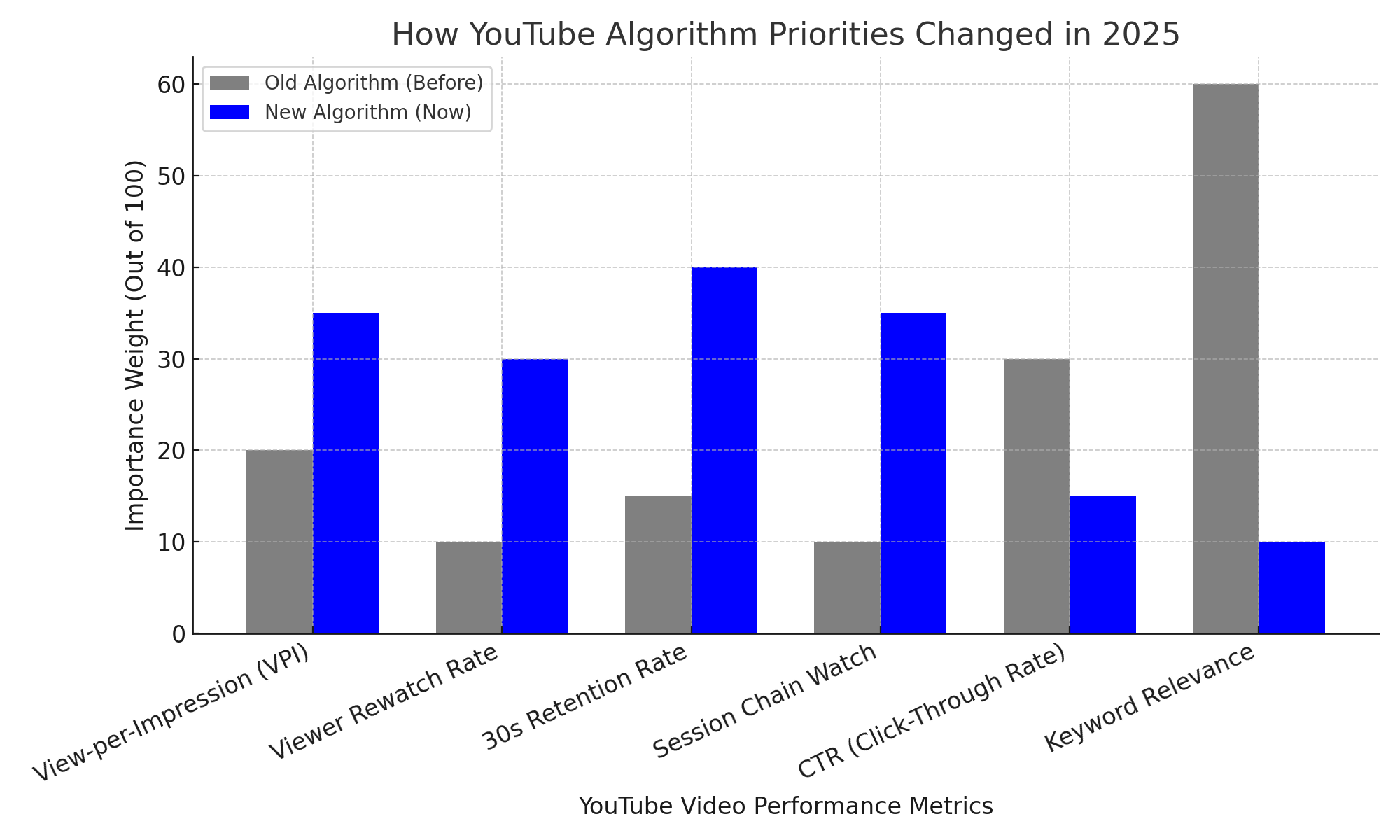
Research shows a shift: the algorithm is giving less weight to raw uploads, keywords, and sub‑count, and more weight to viewer behaviour signals.
Here are the new performance drivers:
Average View‑per‑Impression (VPI)
‑ How many views you get out of impressions served.
‑ The algorithm wants to serve your video to more people only if your view rate is strong.Viewer Rewatch Rate (or Micro‑Loops)
‑ If viewers watch, skip, go to other content, it signals you’re not holding attention.
‑ If they rewatch parts, loop back, or stay throughout, that’s a strong retention signal.Micro‑loop edits / 30s Retention Triggers
‑ The first 30 seconds matter more than ever. If you lose people early, you lose reach.
‑ Strong editing, hooks, pacing matter: micro‑loops (scenes or moments that loop or repeat) increase retention.Session Chain Watch
‑ Your video isn’t just judged on its own — YouTube looks at what happens after.
‑ Does your video keep the viewer on the platform? Does it lead to another video on your channel or elsewhere? That chain behaviour boosts your algorithmic score.Viewer Satisfaction & Personalisation
‑ The algorithm increasingly tailors content based on viewer habits (time of day, device, length, format).
‑ Channels with strong niche audiences and high engagement now out‑perform large channels that only focussed on volume.
🔍 Implications for You as an Artist
Stop chasing sub‑count as the primary metric.
Prioritise retention and session behaviour over simply uploading more.
Your editing, pacing, hook in first 30 seconds — that matters massively.
Instead of clickbait thumbnails, focus on thumbnails & intros that align, deliver value and keep viewer promise — since clickbait can backfire.
Build playlists and encourage “watch next” behaviour — that chain of watch signals is a major boost.
Use data: look at your first 30s drop‑off, view‑per‑impression, rewatch loops and optimise accordingly.
✅ Before vs Now – Quick Comparison Table
| Metric | Old Mindset | New Mindset (2025) |
|---|---|---|
| Upload Volume | High uploads = more reach | Smart uploads = higher retention & session chain |
| Keywords/Tags | SEO tags + keywords | Behaviour signals + niche relevance |
| Clickbait | High click = good | High retention = better than high click |
| Sub‑count | Big sub‑count = strong | Engagement per sub matters more than raw count |
| Shorts vs Long | Shorts > Long | Format chosen based on audience behaviour (e.g., micro‑loops still in both) |
| View:Impression Ratio | Less focus | A core metric: if many impressions don’t convert ‑ reach shrinks |
| Session Chain | Rarely addressed | Critical: your video should lead to another watch |
| Retention (First 30s) | Less obsessively tracked | First 30s now one of the biggest retention drivers |